You learned about energy systems in school. Phosphocreatine, glycolytic, aerobic.
What the textbook couldn’t show you: they’re always working together, just with one more dominant than the others at any given moment. And that dominance shifts depending on everything you did before that effort, not just how hard or long the current one is.
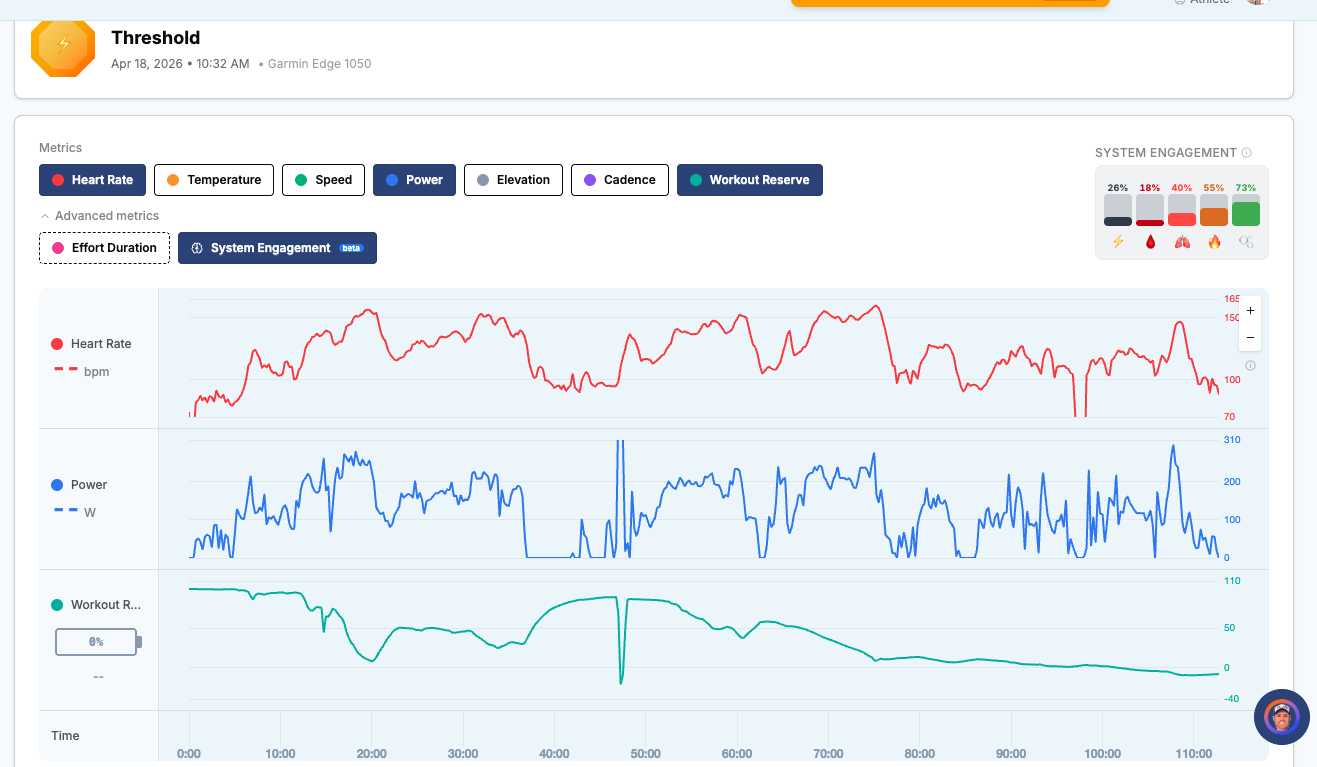
That’s the gap we’ve been working to close. System Engagement, built on the Workout Reserve, now shows you which metabolic domain was the likely bottleneck at any point in your session or race, and how hard it was pushed relative to your personal best. This feature will subsequently assist us to target the adaptations we are looking to develop.
Hello @Prof ,
this looks interesting!
Thanks for the new insights!
One little thing:
Could there be perhaps a short info added in the info section of the New Tool which icon represents which system?
Update: I found the explanation in the link “System engagement” in your article - still, it might be nice if it gets added to the info section of the tool.
If I am reading between the lines correctly; the Workout Reserve Connect IQ data field is already calculating 99% of the data driving the system engagement chart.
I surmise it might be possible to show the system engagement column chart in real time on Garmin devices. Probably not the icons so much. Best on the Edge units as a nice rectangular data field is much easier to work with. Probably really good on the newer xx50 units; with brighter colour display.
Shame my power meter battery contact came away a few weeks ago. I do not have power on the bike at the moment. No system engagement for me for now
Thanks @Phil. I believe you are correct but I’ll leave @Andrea to comment on feasibility. Could certainly be something we want to follow up on. Be a good idea to get that power meter sorted!
Cool! It really helps understanding what I am doing and why.
For some reason it shows zero “aerobic” for my tempo run although I had nice warm-up and cool-down. Day earlier minimal “aerobic” on recovery run. My brains don’t get it.
Long run a couple of days before was normal - 69% “aerobic”.
So I asked AI coach for explanation. It was probably the best experience I have ever had with it. Very good explanation. Right level of detail for me. And it made sense. But I cannot see how it is connected with what the small graph shows. AI coach: “Primary System Engaged: Aerobic system”
Thanks all for the support. It really means a lot. @Phil great suggestion, although we should consider that system engagement can change if I select a different portion of the training session, so I think it should be coupled somehow with a “lap“ feature, and start displaying the system engagement for that lap rather than for all the session from the beginning. @Aet great feedback, that’s what we need to improve our communication around it. Please also consider that you can select specific portions of the session to get your system engagement evaluated. The max potential system engagement is time dependent, therefore if you select different portions of the session you will get different numbers. We use it to evaluate specific drills or climbs or HIIT sets. I believe we have a blog post explaining better these use cases.
Of course, it must be looking at local minima within WR over chosen time durations / periods.
Couple of obvious ways the lap feature could be handled.
A setting for system engagement where the user choses the time duration. For instance they may select 10 mins and the system engagement chart moves from monitoring 0 - 10 mins, 10 - 20 mins etc as the ride progresses.
Connect IQ data fields can see the Garmin native lap timer event. But they cannot tell if it was manually or automatically triggered (for instance by distance, time, or location).
The rider can either press the lap timer manually to determine the start of a period to be watched for system engagement. For instance start of a break away or climb if racing. They can set the lap timer to trigger automatically, using the criteria Garmin natively allows.
There is likely a third way as well, if following a course. You could almost certainly use course points to trigger the start points for system engagement time periods. Thus it could all be setup in advance for certain climbs or sections of a known course / route.
Really enjoying this feature with regard to post session effectiveness and feedback on how well it was executed. I completed a VO2 session today that was quite difficult and the metabolic assessment from AI Coach had my effort spot on with no bottlenecks! I also hit a new benchmark. I now have a reference for what a really good VO2 session should feel like. Thanks for this feature.
Looking forward to learning more about the metabolic systems interaction in general, but also with respect to my subjective feeling during a session.
First of all, thanks for your exceptional work on this platform!
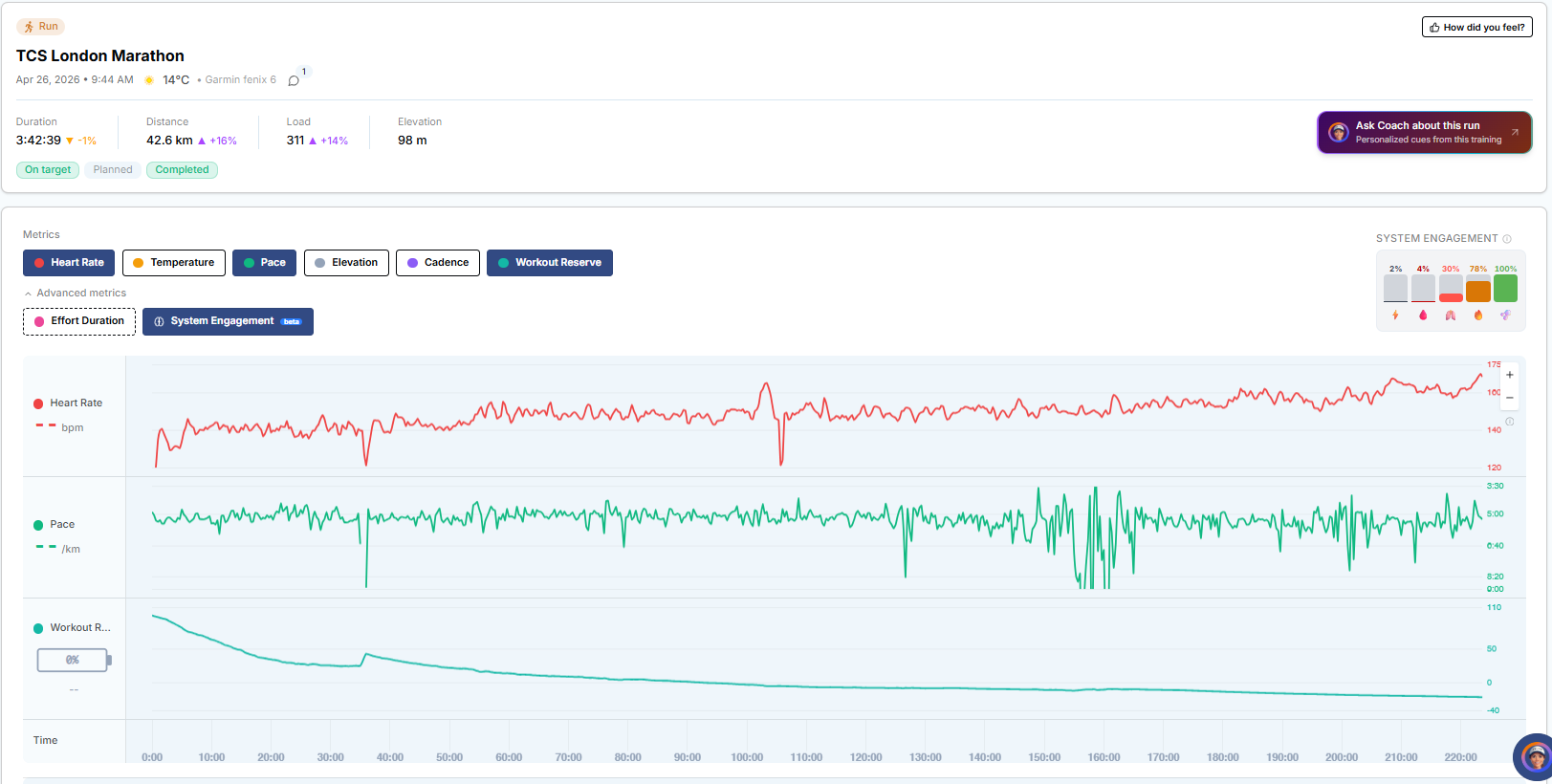
I need some help interpreting the physiological system engagement and metrics from two recent races. I am trying to understand if these outputs match our targets or if we are missing something in our training/pacing strategies. How could i improve?
1. My Race: TCS London Marathon
I would like to understand why I utilized such a small percentage of my VO2max and virtually zero anaerobic capacity during the race.
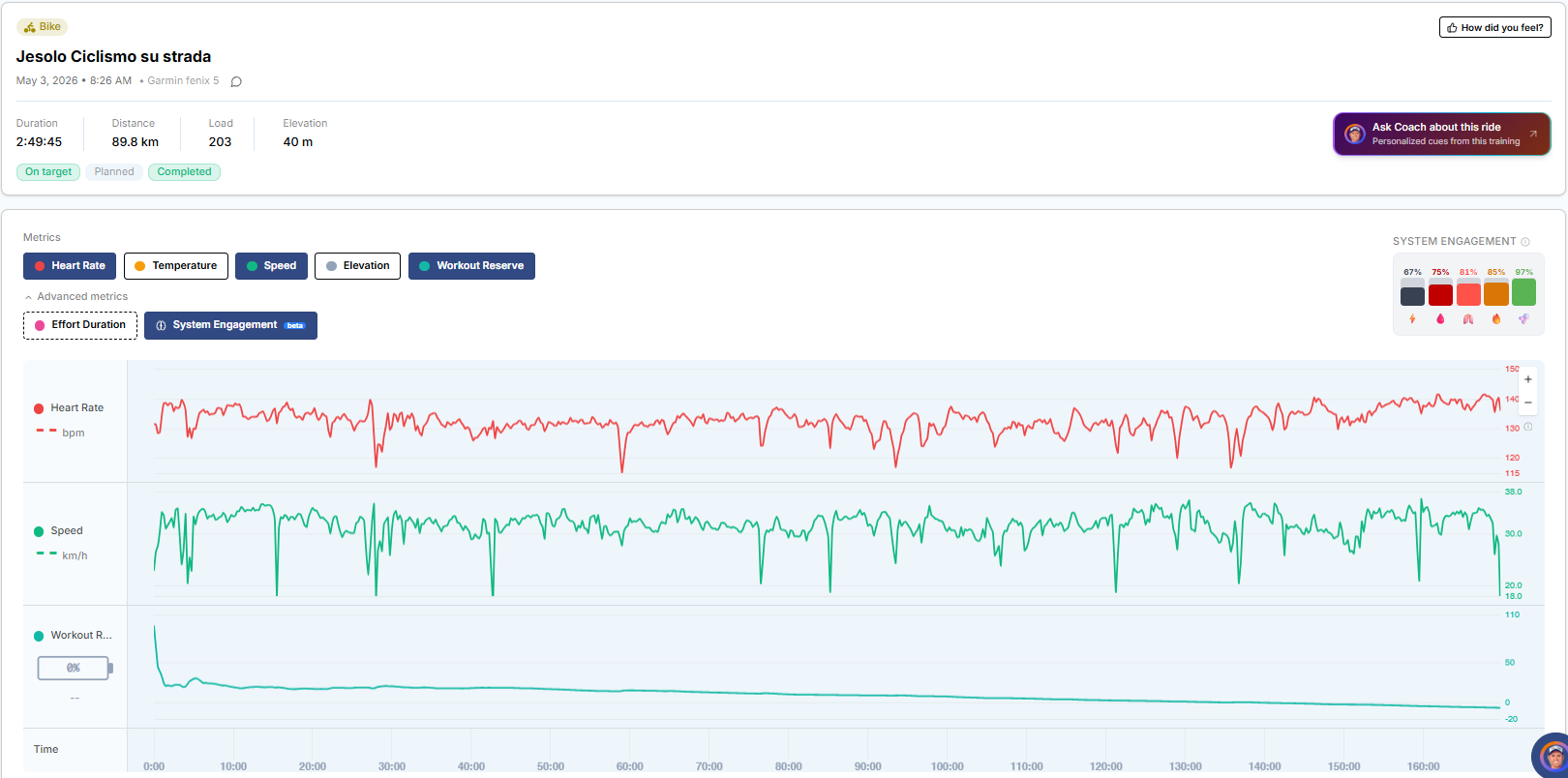
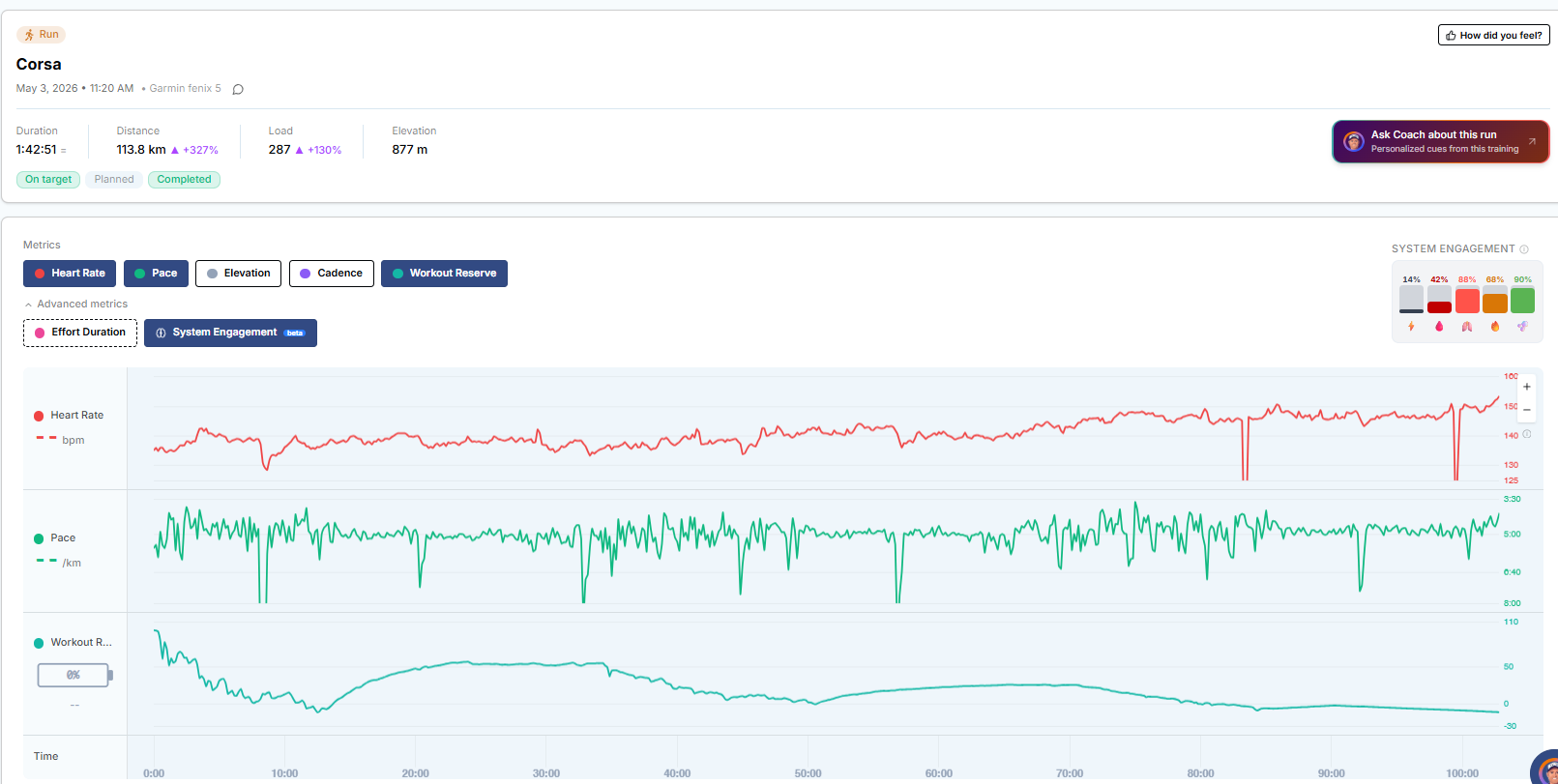
I am also analyzing the file of an athlete I coach. Her system engagement during the bike leg was almost flawless. However, during the run, she couldn’t fully engage her MLSS (Maximal Lactate Steady State) and anaerobic capacity.