I currently have a cold and sore throat. Until recovered i am just doing a daily one hour walk round the local lakes.
Whilst ill; thought i would catch up on the podcast and watched the one where Paul introduces the new AI conversational coach. I was interested to see that the coach has digested the HIIT Science manual. Hear @Marjaana ask it what changes it would make for her upcoming triathlon which has different demands to an Ironman. Hear @Prof say that Athletica is a bunch of tools at your disposal. It doesn’t know everything, and sometimes you need to combine them with your feel to get the best out of it.
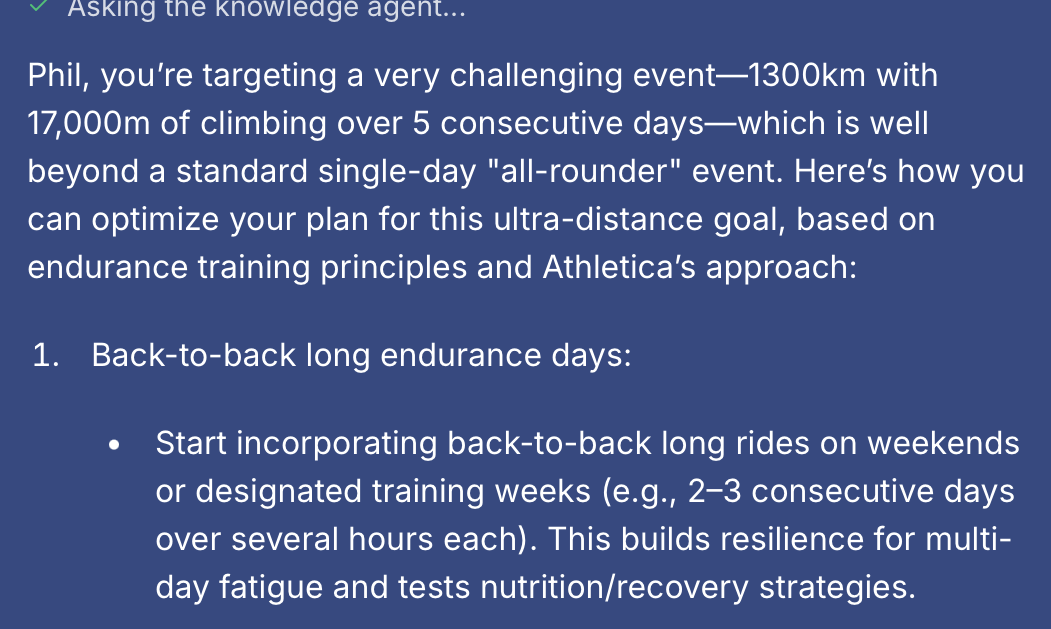
With that in mind I asked the AI conversational coach how it would adapt my plan given the demands of my main A event, a long distance brevet which some will correlate with ultra distance.
I then asked it more specific questions on its optimisations. I asked it to produce a sample training week based on my current training status. I asked it to swap around some of the days. I asked it how it would apply progressive overload to the sample week. I asked it how to get started next week, assuming recovered from my current cold and sore throat.
It really is quite solid in the suggested changes it came up with. So solid, I think I am going to make these changes to my plan. Once I am well again.
Phil, one of my athletes used the AI coach to really dig into preparing for an ultra, and the answers it gave him based on the data were pretty amazing. I was impressed.
I have setup the next four weeks from next week to have a build then recovery, based on the AI coach suggestions which I’ve copied into a Word document for my own reference.
I think what would be really cool is the advanced ability for athletes or coaches to setup
A custom training plan template to cater for the nuances of events not specifically covered by the default training templates.
To be able to select their own custom training plan template as the one to use.
For the AI to apply the principles of progressive overload to that custom training template.
I am guessing that the templates have a sample week for Base, Build, and Recovery.
Thus just like you have community workouts, and your own library. You’d have community / global training plan templates, then your own library specific training plan template(s).
First of all your event truly is a serious challenge! Wishing you all the right ingredients in your preparation: consistency, resilience, and that final sharpness on race day.
Regarding the AI coach integration, I have to be honest: at this stage, I’m not satisfied, and I currently do not see the added value I had hoped for.
Here is a concrete example. I was sick for five days and manually adjusted my training plan accordingly. Unfortunately, there is no “sick flag” or mechanism that dynamically adjusts ATL in such situations. When I then asked the AI coach to review my upcoming four days, I was genuinely surprised that it requested me to manually enter all relevant values, because it does not have access to the existing training plan (!?)
This raises a fundamental question for me: where exactly is the practical value of ATL and integrated AI support if the system is not connected to the core training data?
My main reason for leaving TrainerRoad was the expectation of truly intelligent integration. The concept behind athletica.ai is compelling, and Paul’s decision-support philosophy is outstanding. I am genuinely enthusiastic about that vision.
However, at the moment, the implementation does not yet reflect the ambition behind the idea. It feels as if development capacity might be limiting the platform’s potential.
For those who are looking for meaningful AI support today, I would honestly recommend using ChatGPT as a complementary solution in the meantime. The analytical depth and contextual integration there are currently stronger.
I truly hope to see AI not only in the name “athletica.ai,” but embedded deeply in its functionality and architecture. The vision is powerful — now it needs execution at the same level.